


 Click to Call
 Get Directions





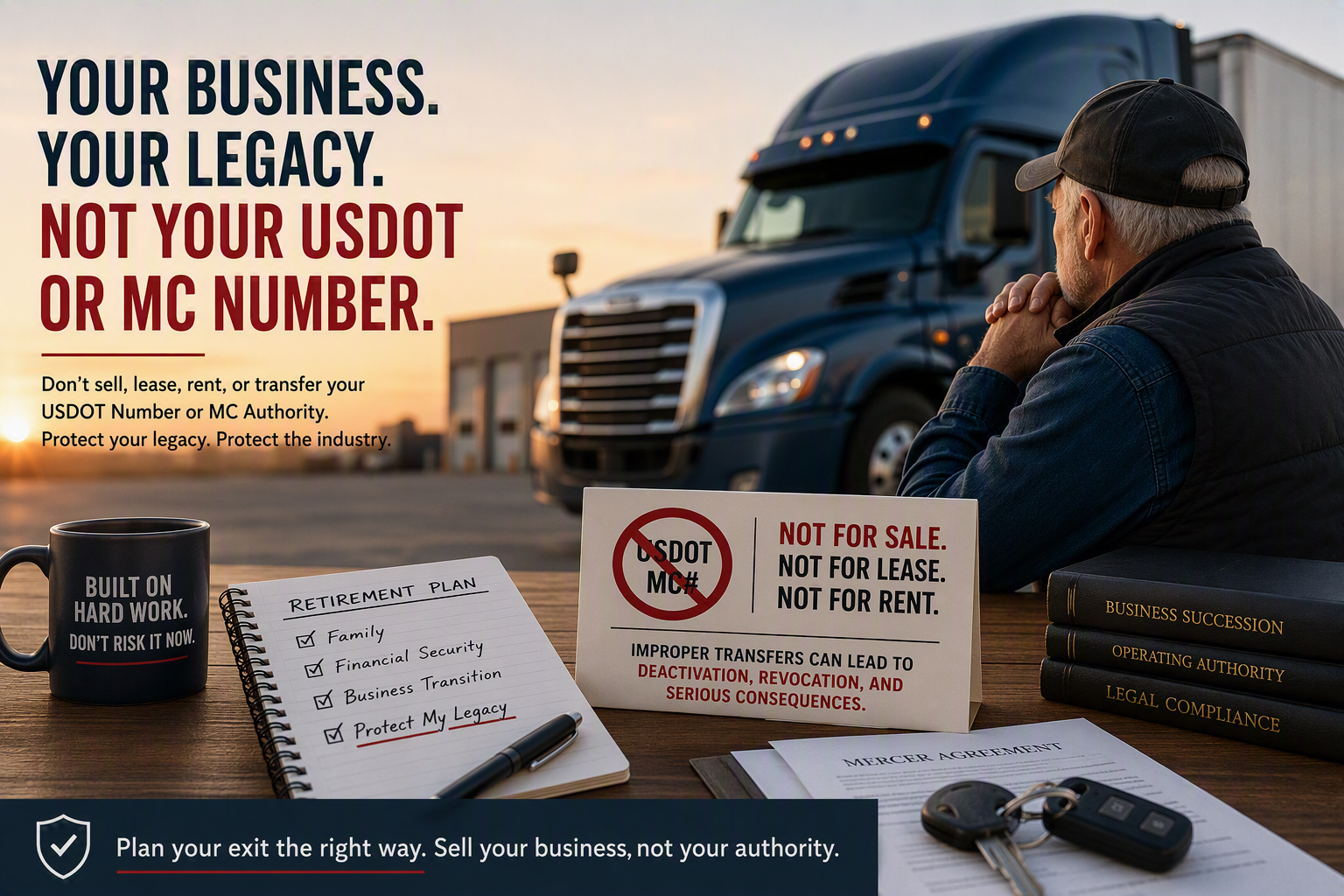
Don’t Make This Costly FMCSA Mistake
By Andrey Shulik, CIC/CRM
Legal Disclaimer
This article is provided for general educational and informational purposes only and should not be construed as legal, regulatory, tax, accounting, compliance, or business succession advice. Federal and state transportation regulations may change, and individual circumstances vary significantly. Motor carriers, brokers, freight forwarders, and business owners should consult qualified transportation counsel, tax professionals, accountants, and compliance advisors before making decisions regarding business sales, mergers, acquisitions, operating authority, USDOT registration, corporate restructuring, estate planning, or ownership transfers.
Many trucking company owners spend decades building their business. Eventually, retirement, health concerns, family considerations, or changing market conditions lead them to consider an exit strategy.
In recent years, an unfortunate trend has emerged. Some business owners have been approached by individuals offering to buy, rent, lease, or otherwise acquire their USDOT Number or MC Authority. Others have seen online advertisements suggesting that operating authorities have significant standalone value and can simply be sold to another carrier.
The Federal Motor Carrier Safety Administration (FMCSA) recently issued a public warning reminding the industry that these transactions may violate federal regulations and could result in serious consequences for everyone involved. [fmcsa.dot.gov], [fmcsa.dot.gov]
Before accepting money for your authority or entering into an arrangement that seems too good to be true, it is important to understand the difference between a legitimate business sale and an improper transfer of operating authority.
Your USDOT Number Is Not a Commodity
A USDOT Number is not like a truck, trailer, or piece of equipment that can be bought and sold.
FMCSA assigns a USDOT Number to a specific legal person or business entity for safety monitoring and regulatory oversight purposes. The agency has emphasized that a USDOT Number belongs to the legal entity to which it was assigned and may not be sold, rented, leased, or transferred to another party outside of a legitimate corporate transaction. [fmcsa.dot.gov], [fmcsa.dot.gov]
In simple terms, if someone approaches you and says:
“I will pay you for your DOT number.”
that should immediately raise concerns.
According to FMCSA, unauthorized transfers may lead to deactivation of the USDOT Number and revocation of associated registrations. [fmcsa.dot.gov], [fmcsa.dot.gov]
The Risk Is Even Greater for Sole Proprietors
Many small trucking companies operate as sole proprietorships.
In the eyes of FMCSA, the business and the owner are often inseparable. If John Doe owns “John Doe Trucking” as a sole proprietor, no buyer can legally become John Doe. As a result, the buyer cannot simply continue operating under John’s USDOT Number after purchasing the business.
The purchaser would generally need to obtain a new USDOT Number and complete the appropriate FMCSA registration process. [fmcsa.dot.gov], [fmcsa.dot.gov]
Owners who are retiring should be particularly cautious when discussing a sale of their business because advice from a broker, friend, or internet forum may not accurately reflect FMCSA requirements.
MC Authorities Are Often Misunderstood
The misconception is even more common when it comes to MC Authorities.
Some individuals believe they can purchase an older authority with established operating history to avoid the challenges associated with a new entrant authority.
FMCSA’s recent guidance makes clear that purchasing or leasing operating authority as a standalone asset may create significant regulatory problems. The agency specifically warns against arrangements involving the sale, purchase, rental, or lease of operating authority outside a legitimate business transaction. [fmcsa.dot.gov], [fmcsa.dot.gov]
Legitimate Business Sales and Succession Planning Are Different
One important distinction often gets overlooked.
FMCSA’s concern is not with legitimate changes in ownership. The agency’s concern is with attempts to sell, rent, lease, or transfer USDOT Numbers or Operating Authority as standalone assets rather than as part of a bona fide business transaction. [fmcsa.dot.gov], [fmcsa.dot.gov], [fmcsa.dot.gov]
In many situations, ownership of a trucking company may change while the underlying legal entity continues to exist. Examples may include:
- Sale of stock in a corporation.
- Sale of membership interests in an LLC that is recognized as a separate legal entity.
- Buyouts between existing shareholders or members.
- Sale of partial ownership interests from one owner to another.
- Business succession planning involving family members.
- Estate settlements following the death of an owner.
- Mergers, acquisitions, and corporate reorganizations. [fmcsa.dot.gov], [fmcsa.dot.gov]
For example, if a trucking company is organized as a corporation and one shareholder sells his or her ownership interest to another shareholder, the company itself may continue as the same legal entity. Likewise, a surviving spouse who inherits ownership interests may later sell those interests to remaining owners as part of an estate settlement. In family-owned businesses, ownership may also pass from one generation to the next through legitimate succession planning.
It is important to understand that these situations are fundamentally different from selling a USDOT Number or MC Authority to an unrelated third party.
Similarly, many LLCs continue operating despite changes in ownership interests. However, structure matters. LLCs that function as separate legal entities with multiple members are generally easier to distinguish from sole proprietorships. By contrast, sole proprietorships and certain disregarded entities may present unique concerns because the business is often legally inseparable from its owner. Buyers should seek competent legal and tax advice before assuming a change in ownership can occur without regulatory consequences.
The critical issue is that the transaction involves ownership of the company itself rather than the purchase or lease of its registration credentials.
If your retirement or succession plan involves transferring ownership of a trucking business, it is wise to consult transportation counsel, tax advisors, and qualified business professionals before completing the transaction. Proper documentation, corporate records, purchase agreements, estate records, and timely updates to FMCSA registration information can be critical to demonstrating that a legitimate ownership change has occurred rather than an impermissible sale or lease of operating authority. [fmcsa.dot.gov]
Why FMCSA Is Paying Attention
The agency’s concern extends beyond paperwork.
FMCSA has long focused on preventing what are commonly known as “chameleon carriers,” which are businesses that attempt to evade enforcement actions, safety violations, unpaid penalties, or poor compliance histories by operating under a different identity. [cdllife.com], [fmcsa.dot.gov]
When authorities are bought, sold, rented, or leased improperly, it becomes more difficult for regulators, customers, insurers, and the public to identify who is actually responsible for transportation operations.
This undermines accountability and creates safety concerns throughout the industry.
Potential Consequences
Motor carriers should understand that an improper authority transaction may create problems far beyond FMCSA compliance.
Potential consequences may include:
- Deactivation of a USDOT Number.
- Revocation of operating authority.
- Loss of authority operating privileges.
- Regulatory investigations.
- Insurance complications.
- Contractual issues with brokers and shippers.
- Delays and expenses associated with re-registering operations.
- Disruption of business operations. [fmcsa.dot.gov], [fmcsa.dot.gov]
A transaction that initially appears to provide a quick payday could ultimately cost both parties substantially more than anticipated.
A Better Approach for Retiring Owners
If you are considering leaving the trucking industry, focus on selling a legitimate business rather than attempting to monetize a USDOT Number or MC Authority by itself.
Before entering negotiations:
- Consult transportation counsel familiar with FMCSA registration requirements.
- Review your corporate structure.
- Determine whether your company is a sole proprietorship, partnership, LLC, or corporation.
- Develop a documented succession plan.
- Verify whether the legal entity will continue after the transaction.
- Notify FMCSA appropriately when ownership changes occur.
- Ensure transaction documents accurately reflect the transfer of the business rather than the transfer of registration credentials.
The value of your business comes from its customer relationships, assets, employees, reputation, operating history, and profitability, not simply from the numbers displayed on the side of the truck.
Final Thoughts
Retirement planning is an important milestone for many trucking company owners. Whether you plan to pass your company to your children, sell your ownership interest to business partners, wind down operations, or pursue a third-party sale, understanding the distinction between selling a business and selling operating authority is critical.
The safest course is to structure any transition as a legitimate business transaction supported by proper legal documentation and professional advice. Attempting to sell, lease, rent, or transfer a USDOT Number or MC Authority outside of those circumstances can expose all parties to significant regulatory and financial risk.
References
Federal Motor Carrier Safety Administration (FMCSA), “DO NOT Sell, Purchase, or Lease a USDOT Number or Operating Authority (MC Number).” [fmcsa.dot.gov]
Federal Motor Carrier Safety Administration (FMCSA), FAQ: “Can I sell my USDOT# or MC# (i.e., operating authority)?” [fmcsa.dot.gov]
Federal Motor Carrier Safety Administration (FMCSA), FAQ: “How do I notify FMCSA of my Operating Authority (OA) ownership change?” [fmcsa.dot.gov]
49 CFR §390.201 – USDOT Registration. [ecfr.gov]
49 CFR Part 365 – Rules Governing Applications for Operating Authority. [law.cornell.edu]
49 CFR Part 376 – Lease and Interchange of Vehicles. [fmcsa.dot.gov]
FMCSA Regulations and Interpretations, 49 CFR Parts 300-399. [fmcsa.dot.gov]
CDL Life, “FMCSA warns truckers not to buy, sell or lease a USDOT or MC number” (secondary industry commentary). [cdllife.com]