


 Click to Call
 Get Directions





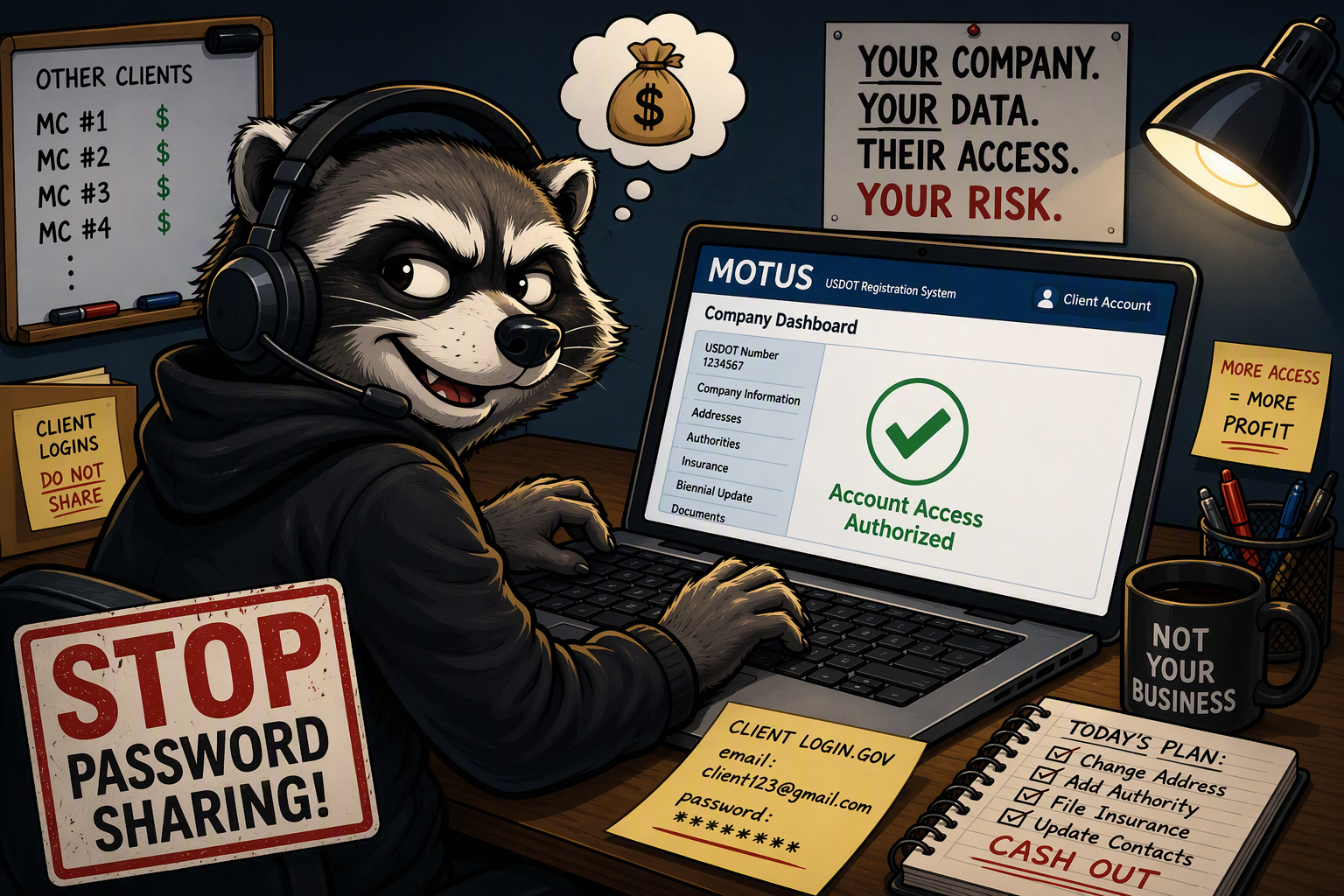
How MOTUS is helping FMCSA combat identity theft, unauthorized account access, and one of the trucking industry’s most dangerous habits.
By Andrey Shulik, CIC/CRM
Why FMCSA Is Tightening Security — and Why That’s a Good Thing
For years, small trucking companies have relied on dispatchers, permit agents, compliance consultants, licensing services, and other third-party providers to help keep their businesses running. There is nothing wrong with seeking professional assistance. In many cases, these service providers play an important role in helping motor carriers navigate regulatory requirements and administrative tasks.
Many of America’s small trucking businesses are owned and operated by hardworking immigrants. These business owners often face significant challenges, including limited time, limited administrative resources, language barriers, and the overwhelming demands of operating a transportation company. Between servicing customers, managing drivers, maintaining equipment, and complying with regulations, it is understandable why many carriers seek outside help.
Unfortunately, this reality has also created a dangerous habit throughout parts of the trucking industry: sharing usernames, passwords, and account credentials.
Far too often, trucking company owners provide access to critical systems by simply handing over their login information. In some cases, they share Login.gov credentials, FMCSA accounts, email passwords, banking access, insurance portals, and other sensitive business systems with individuals they barely know.
Even more concerning, many of these arrangements are established without:
- Written contracts
- Confidentiality agreements
- Privacy policies
- Cybersecurity protections
- Professional liability insurance
- Documented operating procedures
- Proper verification of the service provider’s legitimacy
- Any meaningful control over who actually has access to company data
Many business owners assume that because someone is helping them with permits, dispatching, safety, compliance, or insurance, that person can be trusted with complete access to their business. Unfortunately, that assumption can create significant risk.
Identity Theft in Transportation Has Become a Serious Problem
The transportation industry has experienced increasing concerns surrounding identity theft, fraudulent carrier operations, unauthorized account access, and so-called “chameleon carriers” that attempt to hide poor safety records or enforcement history behind new company identities. As a result, industry participants have significantly increased their focus on verification and accountability.
Freight brokers and shippers frequently use sophisticated onboarding platforms to verify who actually owns and controls a trucking company before awarding freight. Insurance companies are paying closer attention to ownership structures, operational control, and the identities of individuals who represent transportation businesses. Government agencies are also implementing stronger controls designed to reduce fraud and improve accountability.
MOTUS should be viewed in this broader context.
MOTUS Is About More Than Registration
Many carriers see MOTUS as simply a replacement for older FMCSA systems.That view misses a much larger point.
MOTUS was designed to help ensure that individuals accessing carrier information are properly identified and authenticated. The system relies on Login.gov identity verification and is built around the principle that every user should have their own verified identity. This represents a significant shift from longstanding industry habits.
Historically, many companies operated under a simple approach:
“Just give the dispatcher my password.”
Or:
“My permit company handles everything, so they have all my logins.”
Or:
“My cousin set up the account and knows the password.”
Those practices may have been common, but they were never good security. MOTUS is designed to eliminate the need for credential sharing by allowing authorized users to be given appropriate access without requiring the owner to surrender control of the account.
Sharing Login.gov Credentials Is Not Okay
A Login.gov account is intended to represent a specific individual’s verified identity.
When a trucking company owner shares Login.gov credentials with another person, several problems immediately arise:
Nobody can determine who actually performed actions within the system. Multiple individuals may be operating under a single identity. Sensitive company information becomes vulnerable to misuse. Unauthorized changes become difficult to investigate. Former service providers may continue to possess access long after the business relationship ends.
The risk becomes even greater when credentials are shared with individuals or businesses that operate without contracts, licensing, professional insurance, cybersecurity controls, or formal accountability.
Unfortunately, some trucking companies routinely grant complete access to people they have never met in person and know only through social media, messaging apps, or informal referrals.
No business owner would casually hand over the keys to every truck in the fleet to a stranger. Yet many routinely hand over complete access to their digital business.
The Proper Way to Use MOTUS
The model that FMCSA is promoting is actually quite straightforward.
Each individual should maintain their own Login.gov account. Each user should complete their own identity verification.
The business owner should control the company’s MOTUS account in administrator capacity. If assistance is needed, the company administrator can grant appropriate access rights to authorized users. If a relationship ends, those permissions can be modified or removed.
This creates accountability while allowing legitimate service providers to continue helping carriers manage regulatory responsibilities.
Most importantly, it creates a clear record of who is accessing the system and what actions they perform.
A Needed Cultural Change
Technology, cybersecurity, and fraud prevention are no longer issues reserved for large corporations. Small trucking companies face the same threats as larger businesses, often with fewer resources available to protect themselves.
The industry must move beyond a culture where passwords are written on scraps of paper, shared through text messages, sent through social media platforms, or provided to anyone offering administrative assistance.
Professional service providers can and should continue supporting motor carriers. However, that support must be provided through secure access controls, proper authorization procedures, and individual user identities.
MOTUS is not simply another government website. It is part of a larger effort to improve security, reduce fraud, combat identity theft, and ensure accountability within the transportation industry. Carriers who embrace these changes will be better positioned to protect their businesses, their operating authority, and their future.
Because protecting access to your company is every bit as important as protecting the keys to your truck.