HOW CAN WE HELP YOU?

Mobile CallClick to Call
Choice One Insurance, Inc

8800 SE Sunnyside Rd, Ste 225-S
Clackamas, OR 97015

Map IconGet Directions
  • Icon Quote REQUEST A PROPOSAL
  • Arrow Icon
    Icon Auto Motor Carrier
    Defender
  • Arrow Icon
    Icon Home Owner-Operator
    Protector
  • Arrow Icon
    Icon Commercial Contractor
    Defender
  • Arrow Icon
    Icon Life Personal
    Lines
 
  • Choice One Insurance, Inc Blog
  • Contact Choice One Insurance, Inc
  • Make A Payment

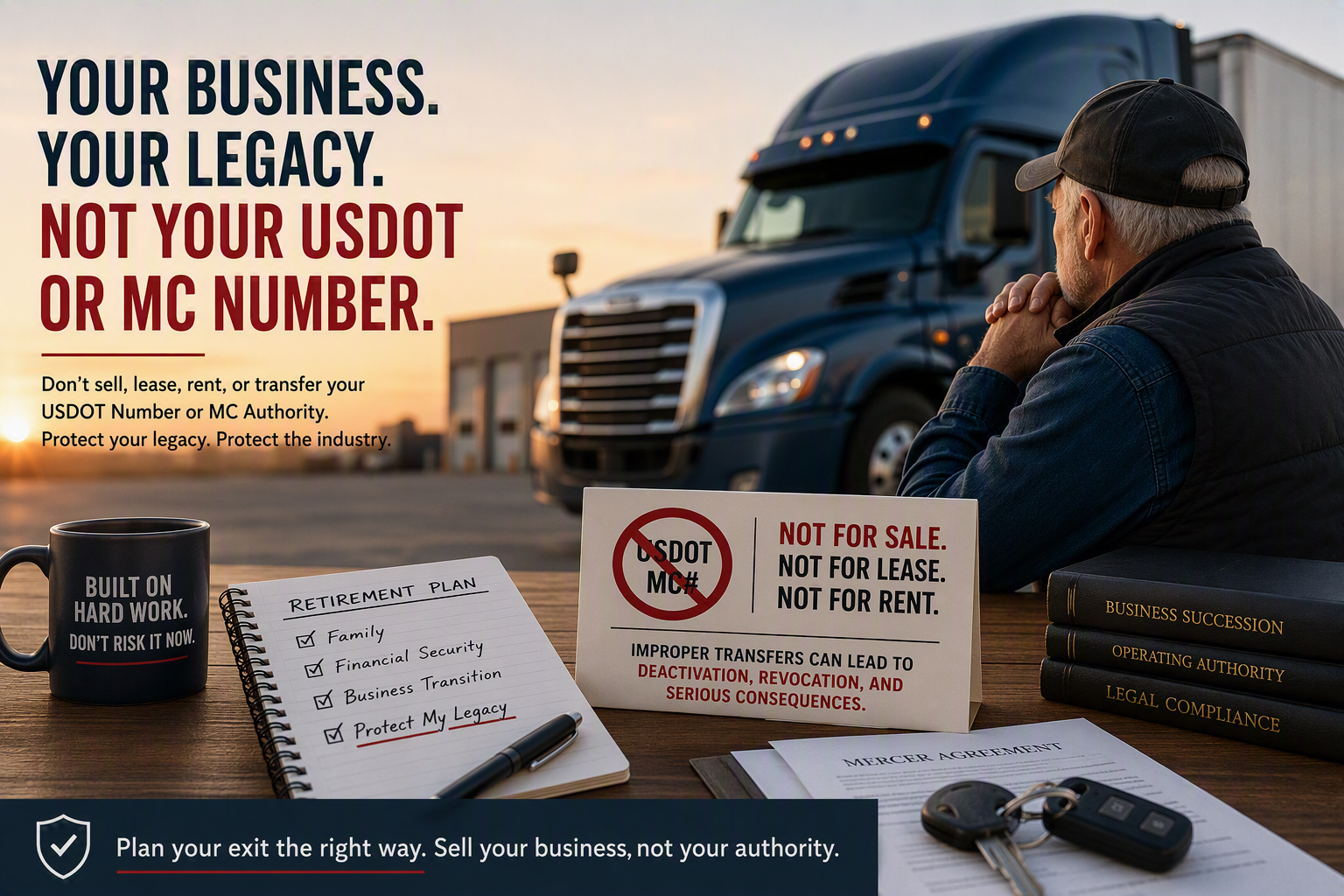
Thinking About Selling Your Trucking Company?

By Andrey Shulik, CIC/CRM


Legal Disclaimer

This article is provided for general educational and informational purposes only and should not be construed as legal, regulatory, tax, accounting, compliance, or business succession advice. Federal and state transportation regulations may change, and individual circumstances vary significantly. Motor carriers, brokers, freight forwarders, and business owners should consult qualified transportation counsel, tax professionals, accountants, and compliance advisors before making decisions regarding business sales, mergers, acquisitions, operating authority, USDOT registration, corporate restructuring, estate planning, or ownership transfers.


Many trucking company owners spend decades building their business. Eventually, retirement, health concerns, family considerations, or changing market conditions lead them to consider an exit strategy.

In recent years, an unfortunate trend has emerged. Some business owners have been approached by individuals offering to buy, rent, lease, or otherwise acquire their USDOT Number or MC Authority. Others have seen online advertisements suggesting that operating authorities have significant standalone value and can simply be sold to another carrier.

The Federal Motor Carrier Safety Administration (FMCSA) recently issued a public warning reminding the industry that these transactions may violate federal regulations and could result in serious consequences for everyone involved. [fmcsa.dot.gov], [fmcsa.dot.gov]

Before accepting money for your authority or entering into an arrangement that seems too good to be true, it is important to understand the difference between a legitimate business sale and an improper transfer of operating authority.

Your USDOT Number Is Not a Commodity

A USDOT Number is not like a truck, trailer, or piece of equipment that can be bought and sold.

FMCSA assigns a USDOT Number to a specific legal person or business entity for safety monitoring and regulatory oversight purposes. The agency has emphasized that a USDOT Number belongs to the legal entity to which it was assigned and may not be sold, rented, leased, or transferred to another party outside of a legitimate corporate transaction. [fmcsa.dot.gov], [fmcsa.dot.gov]

In simple terms, if someone approaches you and says:

“I will pay you for your DOT number.”

that should immediately raise concerns.

According to FMCSA, unauthorized transfers may lead to deactivation of the USDOT Number and revocation of associated registrations. [fmcsa.dot.gov], [fmcsa.dot.gov]

The Risk Is Even Greater for Sole Proprietors

Many small trucking companies operate as sole proprietorships.

In the eyes of FMCSA, the business and the owner are often inseparable. If John Doe owns “John Doe Trucking” as a sole proprietor, no buyer can legally become John Doe. As a result, the buyer cannot simply continue operating under John’s USDOT Number after purchasing the business.

The purchaser would generally need to obtain a new USDOT Number and complete the appropriate FMCSA registration process. [fmcsa.dot.gov], [fmcsa.dot.gov]

Owners who are retiring should be particularly cautious when discussing a sale of their business because advice from a broker, friend, or internet forum may not accurately reflect FMCSA requirements.

MC Authorities Are Often Misunderstood

The misconception is even more common when it comes to MC Authorities.

Some individuals believe they can purchase an older authority with established operating history to avoid the challenges associated with a new entrant authority.

FMCSA’s recent guidance makes clear that purchasing or leasing operating authority as a standalone asset may create significant regulatory problems. The agency specifically warns against arrangements involving the sale, purchase, rental, or lease of operating authority outside a legitimate business transaction. [fmcsa.dot.gov], [fmcsa.dot.gov]

Legitimate Business Sales and Succession Planning Are Different

One important distinction often gets overlooked.

FMCSA’s concern is not with legitimate changes in ownership. The agency’s concern is with attempts to sell, rent, lease, or transfer USDOT Numbers or Operating Authority as standalone assets rather than as part of a bona fide business transaction. [fmcsa.dot.gov], [fmcsa.dot.gov], [fmcsa.dot.gov]

In many situations, ownership of a trucking company may change while the underlying legal entity continues to exist. Examples may include:

  • Sale of stock in a corporation.
  • Sale of membership interests in an LLC that is recognized as a separate legal entity.
  • Buyouts between existing shareholders or members.
  • Sale of partial ownership interests from one owner to another.
  • Business succession planning involving family members.
  • Estate settlements following the death of an owner.
  • Mergers, acquisitions, and corporate reorganizations. [fmcsa.dot.gov], [fmcsa.dot.gov]

For example, if a trucking company is organized as a corporation and one shareholder sells his or her ownership interest to another shareholder, the company itself may continue as the same legal entity. Likewise, a surviving spouse who inherits ownership interests may later sell those interests to remaining owners as part of an estate settlement. In family-owned businesses, ownership may also pass from one generation to the next through legitimate succession planning.

It is important to understand that these situations are fundamentally different from selling a USDOT Number or MC Authority to an unrelated third party.

Similarly, many LLCs continue operating despite changes in ownership interests. However, structure matters. LLCs that function as separate legal entities with multiple members are generally easier to distinguish from sole proprietorships. By contrast, sole proprietorships and certain disregarded entities may present unique concerns because the business is often legally inseparable from its owner. Buyers should seek competent legal and tax advice before assuming a change in ownership can occur without regulatory consequences.

The critical issue is that the transaction involves ownership of the company itself rather than the purchase or lease of its registration credentials.

If your retirement or succession plan involves transferring ownership of a trucking business, it is wise to consult transportation counsel, tax advisors, and qualified business professionals before completing the transaction. Proper documentation, corporate records, purchase agreements, estate records, and timely updates to FMCSA registration information can be critical to demonstrating that a legitimate ownership change has occurred rather than an impermissible sale or lease of operating authority. [fmcsa.dot.gov]

Why FMCSA Is Paying Attention

The agency’s concern extends beyond paperwork.

FMCSA has long focused on preventing what are commonly known as “chameleon carriers,” which are businesses that attempt to evade enforcement actions, safety violations, unpaid penalties, or poor compliance histories by operating under a different identity. [cdllife.com], [fmcsa.dot.gov]

When authorities are bought, sold, rented, or leased improperly, it becomes more difficult for regulators, customers, insurers, and the public to identify who is actually responsible for transportation operations.

This undermines accountability and creates safety concerns throughout the industry.

Potential Consequences

Motor carriers should understand that an improper authority transaction may create problems far beyond FMCSA compliance.

Potential consequences may include:

  • Deactivation of a USDOT Number.
  • Revocation of operating authority.
  • Loss of authority operating privileges.
  • Regulatory investigations.
  • Insurance complications.
  • Contractual issues with brokers and shippers.
  • Delays and expenses associated with re-registering operations.
  • Disruption of business operations. [fmcsa.dot.gov], [fmcsa.dot.gov]

A transaction that initially appears to provide a quick payday could ultimately cost both parties substantially more than anticipated.

A Better Approach for Retiring Owners

If you are considering leaving the trucking industry, focus on selling a legitimate business rather than attempting to monetize a USDOT Number or MC Authority by itself.

Before entering negotiations:

  • Consult transportation counsel familiar with FMCSA registration requirements.
  • Review your corporate structure.
  • Determine whether your company is a sole proprietorship, partnership, LLC, or corporation.
  • Develop a documented succession plan.
  • Verify whether the legal entity will continue after the transaction.
  • Notify FMCSA appropriately when ownership changes occur.
  • Ensure transaction documents accurately reflect the transfer of the business rather than the transfer of registration credentials.

The value of your business comes from its customer relationships, assets, employees, reputation, operating history, and profitability, not simply from the numbers displayed on the side of the truck.

Final Thoughts

Retirement planning is an important milestone for many trucking company owners. Whether you plan to pass your company to your children, sell your ownership interest to business partners, wind down operations, or pursue a third-party sale, understanding the distinction between selling a business and selling operating authority is critical.

The safest course is to structure any transition as a legitimate business transaction supported by proper legal documentation and professional advice. Attempting to sell, lease, rent, or transfer a USDOT Number or MC Authority outside of those circumstances can expose all parties to significant regulatory and financial risk.


References

Federal Motor Carrier Safety Administration (FMCSA), “DO NOT Sell, Purchase, or Lease a USDOT Number or Operating Authority (MC Number).” [fmcsa.dot.gov]

Federal Motor Carrier Safety Administration (FMCSA), FAQ: “Can I sell my USDOT# or MC# (i.e., operating authority)?” [fmcsa.dot.gov]

Federal Motor Carrier Safety Administration (FMCSA), FAQ: “How do I notify FMCSA of my Operating Authority (OA) ownership change?” [fmcsa.dot.gov]

49 CFR §390.201 – USDOT Registration. [ecfr.gov]

49 CFR Part 365 – Rules Governing Applications for Operating Authority. [law.cornell.edu]

49 CFR Part 376 – Lease and Interchange of Vehicles. [fmcsa.dot.gov]

FMCSA Regulations and Interpretations, 49 CFR Parts 300-399. [fmcsa.dot.gov]

CDL Life, “FMCSA warns truckers not to buy, sell or lease a USDOT or MC number” (secondary industry commentary). [cdllife.com]

Finding the Best Commercial Insurance for New Portland Startups

Building and launching a startup in Portland, OR, is an exciting opportunity, but it also introduces financial and legal risks that many new business owners may overlook. From tech startups to creative agencies, selecting the right commercial insurance coverage can help protect your operations, reputation, and long-term growth. At Choice One Insurance Inc., we help startups identify commercial insurance policies that align with their business structure, industry, and risk exposure.

Business Owners Policy Coverage

Many Portland startups begin with a Business Owners Policy, commonly known as a BOP. This type of policy bundles general liability and commercial property insurance into one cost-effective package. A BOP is often well-suited for small to mid-sized businesses and may help provide protection against:

  • Property damage
  • Theft or vandalism
  • Customer injury or liability claims
  • Certain business interruption losses

Additional Commercial Insurance to Consider

Depending on your startup’s operations, location, and staffing needs, additional commercial insurance policies may be necessary, including the following:

  • Professional Liability Insurance: Also known as errors and omissions coverage, this policy is commonly recommended for service-based businesses and helps protect against claims arising from professional mistakes or negligence.
  • Workers Compensation Insurance: Oregon law generally requires businesses with employees to carry workers compensation insurance to help cover medical expenses and lost wages for work-related injuries or illnesses.
  • Commercial Auto Insurance: If your startup uses company-owned vehicles or relies on vehicles for deliveries or business operations, commercial auto insurance is typically required.
  • Directors and Officers Insurance: Startups with board members, investors, or outside leadership may benefit from D&O insurance, which can help protect personal assets against management-related claims.

Choosing the right commercial insurance coverage for your Portland, OR, startup can provide peace of mind as your business grows and evolves. Understanding your insurance options equips you to make confident decisions, regardless of your industry. To learn more about commercial insurance policies designed for startups, contact Choice One Insurance Inc. today.

Cargo Insurance Necessities for Virtual Businesses in Portland

Virtual businesses may not immediately assume they need cargo insurance, but the moment physical goods are shipped, exposure begins. This includes equipment, samples, and inventory moving between locations. In a logistics-heavy city like Portland, OR, gaps between carriers, warehouses, and delivery networks can make insurance decisions even more critical.

At Choice One Insurance Inc., we help virtual business owners understand their cargo insurance options and choose coverage that aligns with how their operations actually function today.

Inland Marine Insurance for Domestic Transit

Despite its name, inland marine insurance covers goods while they are transported over land. This type of coverage is commonly used by e-commerce sellers, businesses shipping products within the United States, and companies with equipment or inventory that is frequently on the move.

Inland marine insurance can help protect shipments during transit between warehouses, fulfillment centers, and customers.

Ocean Marine Cargo Insurance for International Shipping

If your virtual business imports or exports goods, ocean marine cargo insurance is designed to cover overseas shipments. This coverage typically applies to port-to-port transit and may extend to certain risks before and after ocean transport, depending on the policy.

International shipping introduces additional exposures, making this coverage especially important for businesses expanding beyond domestic markets.

Contingent Cargo Insurance

Contingent cargo insurance is important for virtual businesses that rely heavily on third-party carriers. This coverage can help fill gaps when a carrier denies a claim, when carrier liability limits are insufficient, or when disputes delay reimbursement.

It serves as a backup layer of protection when the primary carrier’s coverage falls short.

Inventory Coverage at Storage Locations

If your business uses fulfillment centers, shared warehouses, or home-based storage, separate inventory coverage may be needed. Cargo insurance typically applies while goods are in transit, but coverage for stored inventory often requires a different policy or endorsement.

Business Interruption Coverage

When shipments are lost or damaged, business interruption coverage can help offset lost income and delays in order fulfillment caused by covered events.

Understanding cargo insurance needs is essential for virtual businesses operating in Portland, OR, whether you are just getting started or expanding your operations. The right combination of policies and endorsements can help protect your inventory, revenue, and long-term investment.

To learn more about cargo insurance options for your virtual business, contact Choice One Insurance Inc. to schedule a consultation.

How small does my truck have to be to qualify for Small Truck Insurance / Delivery insurance?

Small truck insurance, also known as delivery truck insurance, is often overlooked because most websites and mainstream articles do not discuss it in detail. However, if you own a delivery truck or use a small truck for business purposes, understanding this type of coverage is essential. Choice One Insurance Inc., serving Portland, OR, is here to help you navigate your options.

Small Truck Insurance

When you explore small truck insurance policies, you will notice that they share similarities, but there are also important differences. One key distinction involves the size of the truck eligible for coverage.

It is important to review insurer requirements, as many companies set specific size limitations for covered vehicles. In general, small trucks comparable in size to pickup trucks or small vans qualify for this type of insurance.

Ask Before Insuring

There is no harm in contacting small-truck or delivery-truck insurance providers to confirm whether your vehicle is eligible for coverage. Before requesting quotes, measure your truck’s length, width, and height to ensure you provide accurate information.

If an insurer declines coverage based on the truck’s size, do not assume you are out of options. Some insurance companies can write customized policies tailored to unique vehicles or business needs. With the right insurer, you can confidently operate your small truck knowing it is properly protected.

Contact Choice One Insurance Inc.

If you own a small truck or plan to purchase one, make sure you have the right insurance. Our team specializes in small truck and delivery truck insurance and proudly serves Portland, OR, and the surrounding areas. Call us at 503-387-5211 to request a quote.

How Tools and Equipment Coverage Protects Mobile Contractors

Mobile contractors face unique risks that office-based businesses never encounter. Your valuable tools and equipment travel from job site to job site, making them vulnerable to theft, damage, and loss. At Choice One Insurance Inc. Services, located in Portland, OR, we understand that specialty contractors’ insurance must address the specific challenges artisan contractors face when working across multiple locations.

Protecting Your Mobile Investment

Construction professionals often carry thousands of dollars’ worth of specialized tools in their vehicles. An experienced tile artisan might transport cutting equipment, levels, mixers, and hand tools worth $15,000 or more. Standard general liability policies typically exclude or severely limit coverage for tools and equipment, leaving contractors financially exposed. Dedicated tools and equipment coverage fills this critical gap by protecting your mobile assets, whether they’re in your truck, at a job site, or temporarily stored at a client’s location.

Coverage Beyond Basic Theft Protection

Quality tools and equipment insurance goes far beyond simple theft coverage. It protects against accidental damage, fire, vandalism, and even mysterious disappearance. If your tile saw gets damaged in a vehicle accident or your construction equipment is destroyed in a client’s garage fire, proper coverage ensures you can replace these essential business assets quickly without devastating your cash flow.

Maintaining Business Continuity

When your tools are stolen or damaged, every day without replacement equipment means lost income. The right insurance policy includes provisions for expedited replacement and may even cover rental equipment costs while you wait for permanent replacements.

Don’t let equipment loss shut down your business. Contact Choice One Insurance Inc. Services, located in Portland, OR, today to learn how comprehensive tools and equipment coverage can protect your mobile contracting operation.

Commercial Insurance for Long- and Short-Term Rentals

Home insurance is only valid if the owner is living in the home. If you own a second house that you rent out long-term or rent out your primary residence for short-term stays, you’ll need landlord insurance to provide coverage in the event of an unfortunate incident.

What is Landlord Insurance?

Landlord insurance is a commercial insurance policy that typically provides liability coverage (for people visiting your tenants), property damage, and lost rental income (if the covered disaster results in the home becoming temporarily uninhabitable). Landlords can add riders to a basic landlord insurance policy if they so desire; popular options include:

  • Flood insurance (always a good idea, as Portland, OR is prone to flooding)
  • Guaranteed income insurance (which compensates landlords if a tenant misses a payment)
  • Emergency coverage (ideal for landlords who live or travel far from a rental property, as it covers the cost of traveling back to your rental property to repair damage)

What is Host Protection Insurance?

The Airbnb platform offers a policy called host protection insurance. It doesn’t take the place of homeowner’s insurance; rather, it acts as your primary policy if you have guests staying in your home. It’s ideal for homeowners who rent a single room, as the policy can apply to part or all of your home. Host Protection insurance covers property damage and bodily injury, but may not offer the full protection you can get from a customized landlord’s insurance policy.

Call Choice One Insurance, Inc. for More Information

Choice One Insurance, Inc. offers a range of commercial insurance options to landlords, business owners, and entrepreneurs in and around Portland, OR. Give us a call to find out more about landlord insurance or to request price quotes.

How Commercial Insurance Benefits Your Employees

Purchasing commercial insurance policies for your business in Portland, OR does more than protect your company. Depending on your industry, you can choose from various specialized policies that safeguard against specific risks. These policies also benefit your employees and, ultimately, you, in ways you might not expect. Choice One Insurance Inc. can help you select the best commercial policies for your business operations.

Beyond Employee Group Health

Many people assume employee benefits only involve group health, dental, and life insurance, along with vacation and personal days. However, other types of insurance can benefit your employees, often in less obvious ways. One of the most straightforward examples is workers’ compensation insurance. Oregon requires businesses with one or more employees to carry a workers ‘ compensation policy. These policies cover medical expenses resulting from work-related injuries or illnesses. They also provide benefits for lost wages during recovery, compensation for disabilities, and financial support for families in the event of a work-related death.

Commercial auto insurance protects employees who drive company vehicles. It covers accident-related costs, including medical expenses, property damage, and potential legal fees, reducing the financial burden on employees.

Professional liability insurance, such as errors and omissions (E&O) coverage, protects employees from claims related to their professional actions. The specific type of liability policy you need depends on your industry.

Enhancing Your Company

When employees know they have these protections, they’re more likely to retain them and attract top talent to your organization. These safeguards enhance employee well-being, increase productivity, and boost morale. With reduced stress and anxiety, your employees can focus better, ultimately benefiting your company.

Discover how various commercial insurance lines can enhance your business. Contact the agents at Choice One Insurance Inc., serving Portland, OR, to get started on securing the right commercial insurance policies.

Piracy is Still a Thing! How to Protect Against It

Even in the 21st century, piracy remains a real threat—not just digital piracy, but the classic "Arr, matey" kind. Modern pirates may not speak with a West Country accent or wield cutlasses, but they are armed, often with assault rifles, and capable of hijacking boats and ships to steal cargo and anything of value. If items are bolted down, they may even unbolt them. In some cases, pirates may take the crew hostage and demand a ransom. While most piracy attacks occur in East Asia, it only takes one armed and desperate criminal on the Willamette River to cause significant harm.

How to Protect Against Piracy

Modern pirates often use small, fast, and highly maneuverable speedboats, making them difficult to detect until it’s too late. To reduce the risk, give a wide berth to any speedboats on the water, especially if they appear to be following your vessel. Be cautious of boats pretending to be in distress, as this is a common tactic used by pirates to lure ships closer. Some shipowners take proactive measures, such as lining the perimeter of their deck with razor wire to deter boarding attempts.

If pirates do manage to board your vessel, prioritize safety over resistance. It’s better to surrender cargo than to risk human lives. Fortunately, the financial loss from stolen cargo can be mitigated with cargo insurance. Cargo insurance helps businesses recover financially after a piracy incident, ensuring that the cost of lost goods doesn’t jeopardize operations.

Contact Choice One Insurance in Portland, OR

If you’re in the Portland, OR area and believe cargo insurance is a smart investment for your business, contact Choice One Insurance Inc. We’re here to help you protect your assets and prepare for the unexpected.

Small Truck Insurance – Protection Against Collisions

Lacking insurance or having insufficient coverage can result in severe repercussions. Appropriate small truck insurance safeguards you in case of a collision, covering out-of-pocket expenses for which you are directly accountable.

Liability Protection

Your small truck insurance policy can offer liability protection. In the event of an accident involving your small truck, you may need to cover repair costs.

If you are deemed responsible, your small truck insurance policy could cover the expense of repairing the other party’s vehicle. It could also cover any medical bills and legal expenses related to the accident. The policy may compensate you for attorney fees and other legal costs you incur.

Collision Protection

Your small truck might be involved in an accident that results in body damage. Such damage may necessitate professional automotive services. Your policy can include collision protection, which covers the cost of repairing or replacing your vehicle.

Body damage incurred during a collision may be covered by this type of insurance. The insurance may compensate you for dent removal services, paint restoration services, and essential automotive inspections.

Initial Evaluation

An evaluation of your small truck and your driving habits will help determine the amount of small truck insurance you need. Consider the condition of your truck and the frequency of its use.

Support from Insurance Agents

Are you interested in learning more about small truck insurance? If so, reach out to one of our Choice One Insurance Inc. agents. An agent serving the Portland, OR region will explain the types of coverage you may need to safeguard your vehicle.

Which Businesses Need Cyber Insurance?

If your business uses a computer system, you probably need cyber insurance. As the number of threats increases, more businesses get this type of insurance. Computer systems are highly vulnerable to a wide range of risks in today’s internet landscape. A business must be covered to protect it against these costly risks. To get started with a policy, call us at Choice One Insurance Inc. in Portland, OR.

Cyber Insurance and Its Importance in Modern Business

No matter what type of company it is, it will likely rely heavily on a computer system these days. These systems hold a lot of data needed to run your business. This can include data about your employees, customers, and financial situation. There are likely countless critical digital files, but all of them are at risk today.

Understanding the Risks in Business Operations

Doing business comes with a wide range of possible risks. A computer system is a prime target for many criminals who want to steal data from it or hold it for ransom. Simply wiping out the files could be devastating for a small business. What could be just as bad is if the data were stolen and leaked online. Cleaning up this could be expensive, but cyber insurance can cover those high costs. Without this insurance, your business is vulnerable to the aftermath of a cyber attack.

Get Cyber Insurance in Portland

When you have a business that uses computers, it’s always better to be well-protected for the sake of your business. To get started with a cyber insurance policy, call us at Choice One Insurance Inc. in Portland, OR.


Reviews


Latest news and articles